A Florida Builder's Guide to Crane Lift Exclusion Zones
A finished elevated foundation doesn't make a site ready for a crane. During modular home installation, crane lift exclusion zones must protect people around the rotating equipment, along the suspended load's route, and near the landing points.
The starting point is separate hazard boundaries , rather than one ring of caution tape around the crane. Those boundaries must match the equipment, lift sequence, elevated concrete structure, and surrounding property.
Start by separating the hazards that require different controls.
Understand What Crane Lift Exclusion Zones Protect
Federal OSHA's construction crane standards apply to most private-sector construction work in Florida. Two provisions shape exclusion-zone planning: 29 CFR §1926.1424 for swing-radius hazards and §1926.1425 for keeping clear of loads.
Neither establishes one universal exclusion-zone radius for every crane or modular set. The boundary follows the actual hazard.
The rotating crane creates a swing and crush zone
The crane's rotating superstructure can trap someone against a wall, parked vehicle, material stack, or another fixed object. The counterweight deserves attention because workers may watch the suspended module and overlook movement behind the operator.
Under §1926.1424, employers must train authorized personnel and mark foreseeable pinch or crush hazard boundaries. Control lines, warning lines, railings, or similar barriers can identify that area.
This boundary follows the equipment's rotation and nearby obstructions. It doesn't automatically cover the suspended module's route.
The suspended module creates a separate fall zone
OSHA defines the fall zone as the area where suspended materials could reasonably fall during an accident. For a modular section, that area changes as the crane lifts, rotates, and lowers the load.
Section 1926.1425 requires hoisting routes that minimize employee exposure. During landing, only employees needed to receive the load may enter its fall zone.
A counterweight barrier can remain correctly positioned while the suspended module's fall zone moves well beyond it.
Map the Entire Lift Path Before Delivery
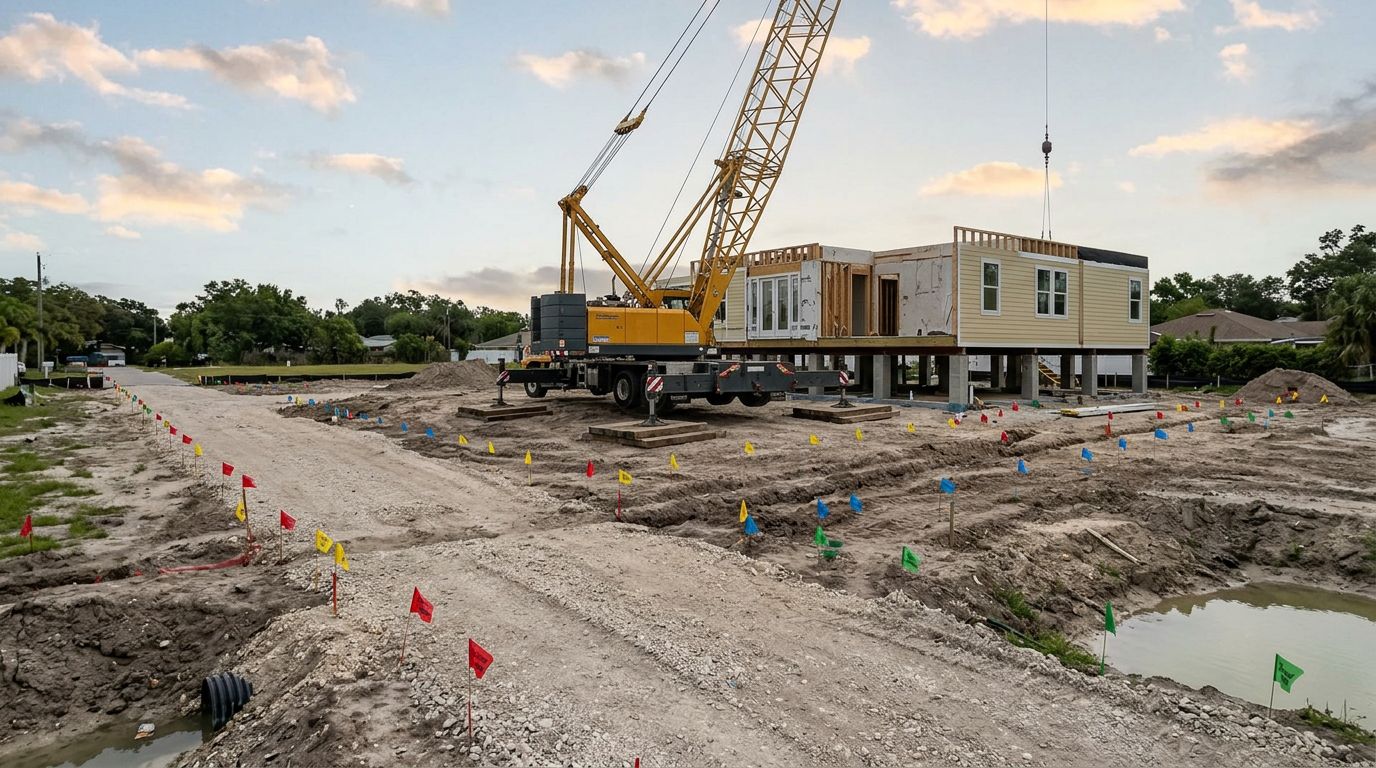
A useful site plan shows more than the crane parking location. It connects the delivery trailer, pickup point, travel path, elevated landing position, and controlled pedestrian routes.
For a Key West project, nearby homes, narrow frontage, overhead utilities, and limited staging space belong on that same plan. Each can change where the boundaries fall.
Draw the pickup, travel, and landing areas
Map each module's route individually. Sections may arrive in a particular order, and the first placement can obstruct the path needed for a later section.
Show where rigging attaches, where the module leaves the trailer, and where workers receive it. Also identify areas below an elevated landing position that must remain clear.
Our guidance on restricted coastal delivery access connects truck placement with crane positioning. A truck route can work while leaving insufficient space for outriggers or controlled access.
Include people outside the construction crew
Homeowners, neighbors, delivery drivers, and other trades need routes that stay outside the hazardous areas. A driveway entrance or sidewalk crossing can become an access point into the lift path.
Where operations affect a public roadway or sidewalk, traffic and pedestrian controls must address that exposure. A property-line fence alone doesn't control a load traveling beyond it.
Plan access before trucks arrive so drivers don't improvise a waiting location beside the crane.
Make Elevated Concrete Part of the Lift Plan
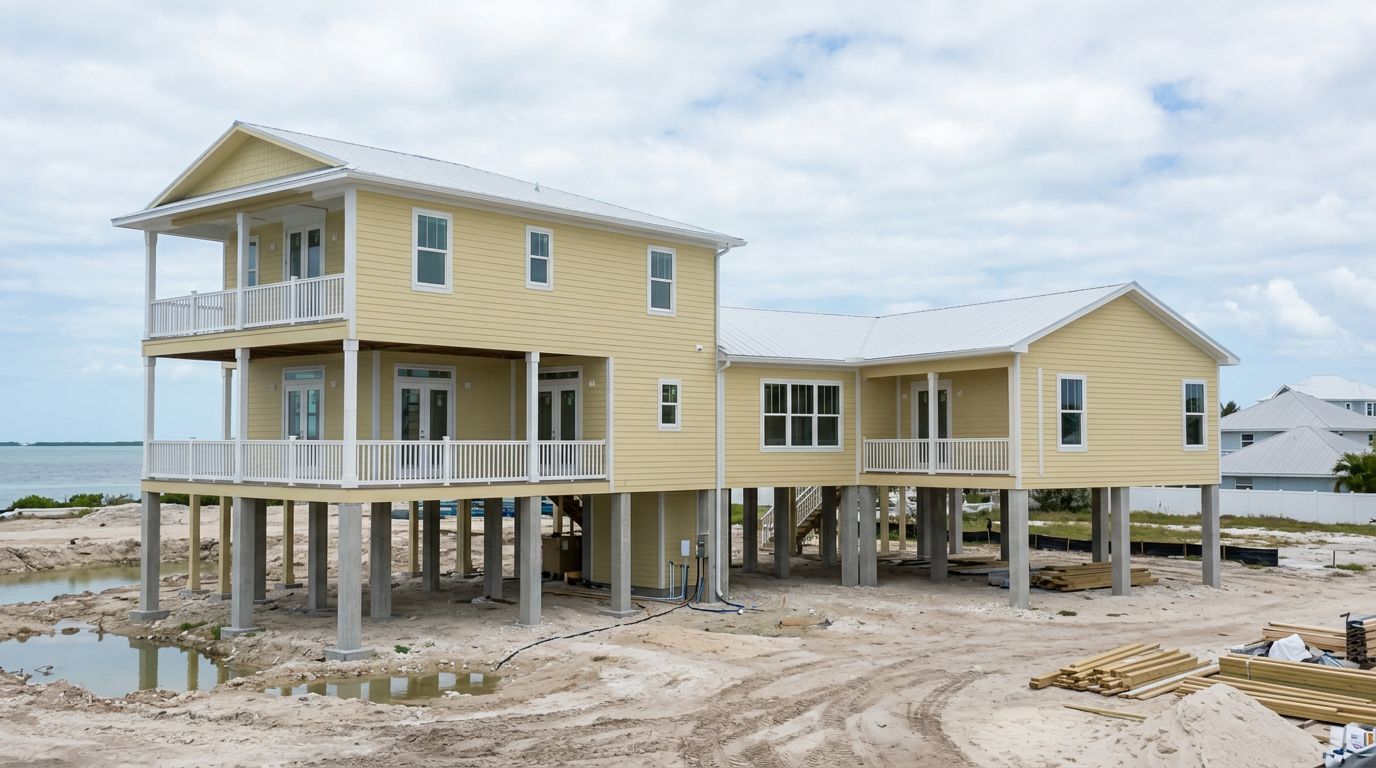
Elevated coastal structures change both the landing geometry and worker access. Columns, beams, and modular-bearing supports must match the approved structural design before setting begins.
At Mod Tech Construction, we coordinate access, staging, crane position, rigging, set sequence, module alignment, and structural connections. Our concrete work supports that same installation sequence.
Foundation readiness controls the landing operation
For modular home setup in Naples, the crew needs accurate bearing locations, elevations, and connection details. Concrete must have the required strength, and applicable inspections must be complete before it receives the modules.
An out-of-position bearing point can force installers to improvise while a section remains suspended. Resolving that mismatch beforehand reduces time spent near the load.
Our guide to elevated foundation lift planning connects foundation geometry with crane reach and placement.
Crane support ground needs its own assessment
The home's foundation and the crane's support area perform different jobs. Finished columns don't establish that nearby fill, paving, or soil can carry outrigger reactions.
In Fort Myers, utility trenches, saturated ground, and canal edges can affect equipment placement. Mats or other support measures must suit the ground and crane loading.
The planning considerations in our guide to coastal crane support ground also matter where foundation excavation has disturbed the setup area.
Establish Barriers and Controlled Entry Points
Exclusion boundaries need to be visible before lifting starts. They also need someone responsible for keeping them effective as deliveries, workers, and equipment move.
On a Sarasota site, the route to a tool trailer or parked vehicle may cross the planned lift area. Move that routine traffic away from the operation rather than relying on repeated verbal warnings.
A practical setup sequence is:
- Mark the swing and crush boundary around the crane's rotating superstructure.
- Establish controlled areas along the planned suspended-load route and landing position.
- Assign responsibility for entrances, pedestrian diversions, and delivery movements.
- Brief everyone on access restrictions, signals, and stop-work authority before the first pick.
The briefing must explain what each boundary controls. A person permitted near the crane for one task doesn't automatically have permission to enter the load's fall zone.
Keep barriers visible and maintain clear escape routes for the landing crew. Meanwhile, tools and loose materials should stay out of those routes.
For homeowners, the safest viewing location is outside the controlled work area, in a position agreed with the site team.
Keep Power-Line Clearance Separate From Ground Barriers
Overhead electrical clearance requires its own planning. Ground-level tape doesn't prevent a boom, rigging assembly, tag line, or suspended section from approaching an energized conductor.
Under 29 CFR §1926.1408, operations near lines up to 350 kV can use a 20-foot minimum clearance or the applicable voltage-based Table A procedure. Another regulatory option is having the utility owner de-energize and visibly ground the line at the worksite.
The 20-foot figure isn't a universal clearance for every voltage or operating arrangement. The applicable procedure determines the required distance and protective measures.
Assess clearance across the full operating path. A boom can remain clear at pickup but approach a conductor as it rotates toward elevated supports.
Also distinguish the load signal person from a dedicated power-line spotter. Under the applicable procedure, a dedicated spotter's only duty is observing clearance and maintaining continuous contact with the operator.
On compact Gulf Coast properties, relocation of the crane or delivery trailer may be necessary to create a workable route. Electrical clearance belongs in the initial layout, before foundation work restricts those options.
Assign Communication and Landing Responsibilities
Everyone should know who directs the lift and who controls access. Written responsibilities are useful, but the pre-lift briefing must translate them into actions for that day's setup.
On a Tampa project, an elevated beam or neighboring building may block the operator's view even when the crane has adequate reach.
Use a qualified signal person when required
Under 29 CFR §1926.1419, a signal person is required when the operator lacks a full view of the point of operation. The rule also covers obstructed travel views and site-specific circumstances that require signaling.
Agree on the signaling method before lifting. Radio users need a clear channel, understood commands, and a response for lost communication.
Only one person should give operational signals at a time, although anyone who recognizes a hazard can give a stop or emergency-stop signal.
Keep the receiving crew small and prepared
Only employees needed to receive the module belong in the fall zone during landing. Observers and unrelated trades must remain outside it.
The receiving crew needs planned working positions and appropriate access to elevated connections. Fall protection for elevated work remains a separate requirement; exclusion barriers below don't address that exposure.
Before releasing rigging, the crew must complete the support and securing steps required by the installation sequence. Alignment, structural fastening, and marriage-line work then proceed in their planned order.
Stop When Weather or Site Conditions Change
Wind affects a large modular section differently than a compact load. Its exposed surfaces can rotate or move even when the crane has sufficient lifting capacity.
For Florida Keys projects, operating limits must follow the crane manufacturer's requirements and the lifting arrangement. The team must account for gusts, load control, visibility, and changing weather, rather than adopting a generic wind cutoff.
Rain can also change ground conditions beneath equipment. Pause when storms, lightning, unstable support, or lost communication make the operation unsafe.
Our pre-lift rigging inspection checklist connects equipment checks with foundation readiness, weather, and site conditions.
A changed crane position requires a renewed review of radius, capacity, ground support, electrical clearance, and exclusion boundaries. Moving a barrier alone doesn't address those changes.
Reassess access after each significant placement, too. A landed module may obstruct sightlines or close a route that the next lift needs.
Key Takeaways for Coastal Set Day
A workable exclusion plan connects the crane operation to the delivery route and elevated structure.
- Treat the rotating crane's crush hazards and the suspended load's fall zone as separate controlled areas.
- Resolve foundation alignment, crane support, electrical clearance, and worker access before modules arrive.
- Keep receiving personnel to those needed for the task, with clear signals and stop-work authority.
- Reassess the operation when weather, equipment position, or the placement sequence changes.
These controls belong in installation planning, alongside concrete readiness and structural connections. Leaving them until the first truck arrives limits the team's options.
Build the Exclusion Plan Into the Installation
A completed coastal foundation is only one part of a safe modular set. Controlled access must follow the crane's movement and the suspended section's route.
Plan those boundaries alongside delivery, elevated concrete, landing access, and communication. Keep them active until the lifting hazards end.
The goal is a setting sequence in which every person knows where they can work, when they can approach, and who can stop the operation.
Recent Posts