Crane Power Line Clearance for Florida Modular Sets
A crane can reach your foundation and still have no safe path past the overhead wires. For a coastal modular home installation, crane power line clearance depends on the entire lift path , including the suspended section, rigging, and equipment movement.
That matters on tight Florida lots, where elevated concrete supports, narrow streets, and utility poles compete for space. Start with a site-specific clearance plan before scheduling delivery or committing to the crane position.
Key Takeaways for a Safe Modular Set
- OSHA's 20-foot option isn't a universal minimum; voltage-based clearances require confirmed voltage and the required safeguards.
- Clearance applies to the crane, load line, rigging, lifting accessories, and full suspended module.
- Elevated foundation design and crane access need coordinated planning before concrete work starts.
- Utility arrangements, foundation readiness, weather limits, and crew responsibilities should be settled before trucks arrive.
Map the Entire Crane Work Zone
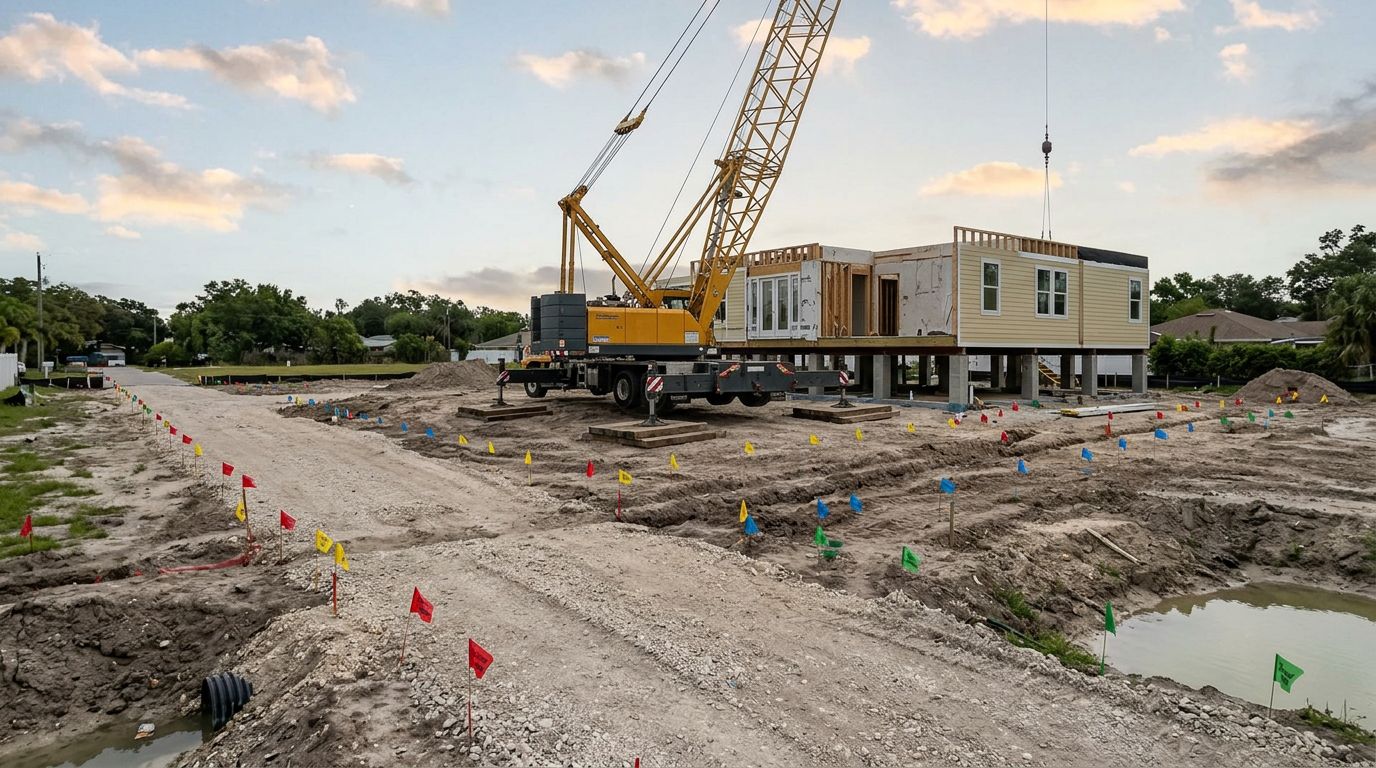
The first site review should locate overhead conductors alongside the proposed crane position, delivery staging area, and foundation. On a compact Key West parcel, the available setup space can determine whether the planned installation is workable.
Include More Than the Boom Tip
OSHA § 1926.1408 requires an assessment of whether equipment, the load line, or the load could come within 20 feet of a power line. That assessment considers operation at the equipment's maximum working radius within the defined work zone.
For a modular set, the load includes the full section, plus rigging and lifting accessories. A module's corner can approach a conductor even when the boom appears clear. Rotation, suspended-load movement, and the approach to elevated bearing points all belong in the assessment.
Review Each Pick and Landing Position
Trace the movement between the truck and foundation for every section. Include pickup, rotation, placement, and rigging removal, rather than checking only the final landing point.
In the Florida Keys, limited staging space may require a delivery sequence that differs from a mainland job. The team also needs to consider conductor sag and movement. Qualified personnel should establish distances without approaching energized lines with measuring poles or other objects.
Record the work-zone limits so everyone understands where crane movement must stop.
Understand OSHA's Crane Power Line Clearance Options
For lines rated up to 350 kV, OSHA § 1926.1408 provides three routes when the assessment identifies a potential approach within 20 feet:
- Have the utility owner/operator deenergize and visibly ground the line at the worksite.
- Maintain 20 feet and implement the required encroachment-prevention measures.
- Confirm the voltage, maintain the applicable Table A distance, and implement the required measures.
OSHA's Table A sets these minimum approach distances.
| Power-line voltage | Minimum approach distance |
|---|---|
| Up to 50 kV | 10 feet |
| Over 50 through 200 kV | 15 feet |
| Over 200 through 350 kV | 20 feet |
| Over 350 through 500 kV | 25 feet |
| Over 500 through 750 kV | 35 feet |
| Over 750 through 1,000 kV | 45 feet |
| Over 1,000 kV | Established by the utility owner/operator or a qualified registered professional engineer |
The table doesn't authorize a crew to choose a smaller distance based on appearance. A 10-foot clearance applies only within its voltage range and with the required precautions.
A line that appears to be an ordinary neighborhood distribution line still needs voltage confirmation before the crew uses a voltage-based clearance below 20 feet.
Lines above 350 kV fall under OSHA § 1926.1409, which adds requirements. Don't apply the lower-voltage planning procedure unchanged to those lines.
For a Naples installation, an apparent conflict should trigger utility coordination or a revised lifting layout before equipment mobilization. Clearance planning must precede the crane booking.
Coordinate With the Utility Before Delivery
Treat overhead lines as energized unless the utility owner/operator confirms otherwise. Turning off a home's electrical service doesn't establish that nearby overhead conductors are deenergized.
Confirm Voltage and Any Planned Outage
Identify the serving utility and request the information needed for the lifting plan. Florida Power & Light publishes electrical safety guidance, but its guidance doesn't replace OSHA requirements or project-specific utility confirmation.
If deenergizing is the selected route, arrange it through the utility owner/operator. The OSHA option requires visible grounding at the worksite, not simply an outage assumption.
For a Fort Myers project, written coordination should identify the affected lines, scheduled work, responsible contacts, and any conditions that could change the set date. Don't assume a requested outage has been approved.
Assign the Crew's Clearance Safeguards
The employer must implement the measures required for the selected clearance option. These include crew planning and applicable encroachment controls.
Depending on the rule's requirements, controls may involve warning boundaries, a dedicated spotter, range controls, proximity alarms, or other approved measures. A device doesn't replace the required clearance.
The spotter needs an effective view and reliable communication with the operator. Establish stop instructions before lifting begins. If the module blocks the view or communication fails, stop the affected operation and restore the safeguards before continuing.
Design Elevated Concrete Around the Set
Foundation approval and electrical clearance address different hazards. An elevated concrete structure can meet its engineering requirements while leaving no workable route for the crane or delivery truck.
Resolve Elevation and Bearing Details Early
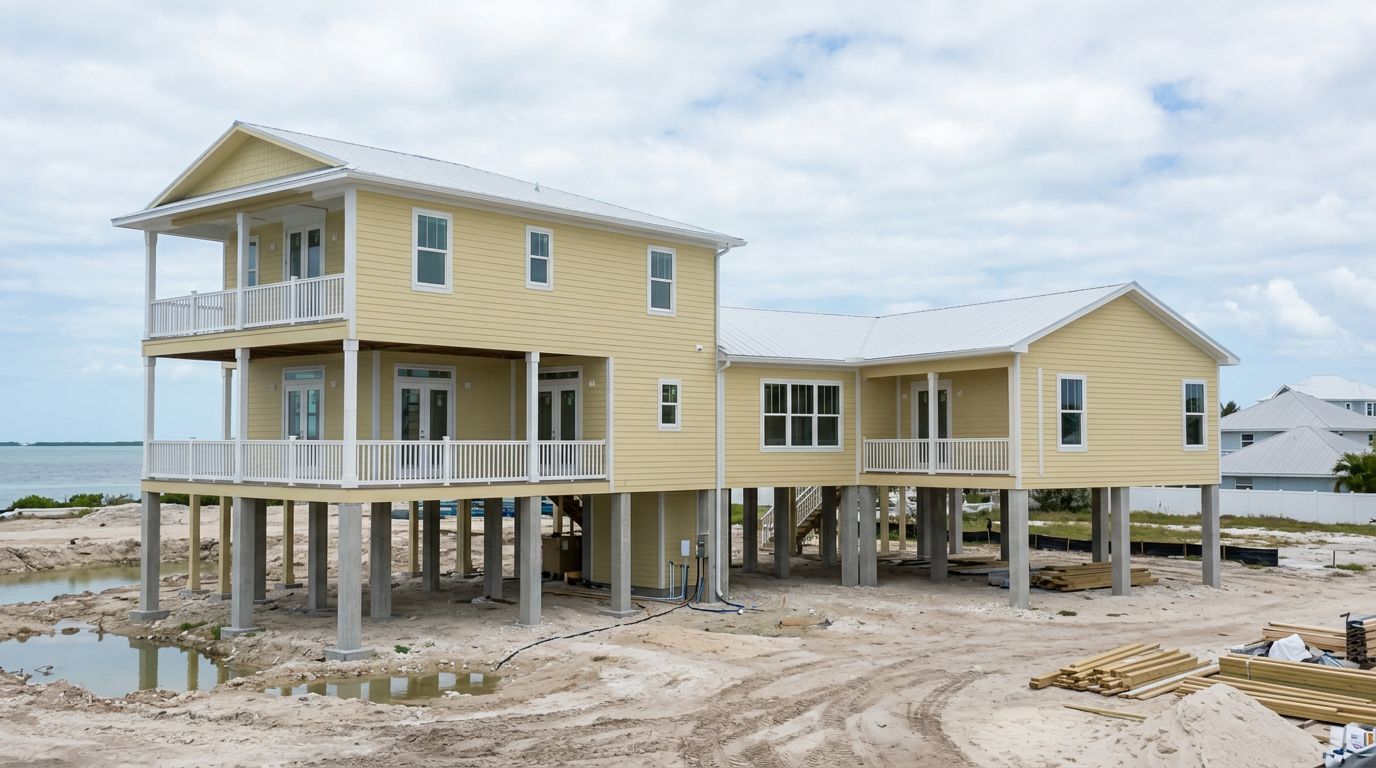
For coastal modular home setup, the foundation design depends on the parcel's flood conditions, soil, wind loads, and approved engineering. Reinforced concrete columns, piers, grade beams, piles, or elevated slabs may form part of the support system.
In Sarasota, confirm the property's flood information through FEMA's Flood Map Service Center and the governing building department. The approved design elevation and local requirements control the project.
Elevation also affects the lifting geometry. Raising the landing point changes the required hook height and equipment configuration. Resolve those relationships before forming the concrete, rather than treating crane access as a later task.
Verify Readiness Before Releasing Deliveries
The foundation must reach the condition required by the engineer and approved plans. Complete the required inspections and verify elevations, bearing locations, and connection details before scheduling the set.
In Tampa and nearby gulf coast communities, underground utilities and future trenches also need coordination with crane bearing areas. Excavations can affect ground support even when they sit outside the foundation footprint.
A surveyed foundation doesn't establish that the crane pad can carry outrigger loads. The installation team needs separate confirmation of equipment support and access.
Check Crane Capacity, Ground Support, and Weather
Electrical clearance doesn't establish lifting capacity. The crane provider must evaluate the module's confirmed weight, rigging, operating radius, configuration, and landing height against the applicable load chart.
A position farther from the lines may increase radius and reduce available lifting capacity. Therefore, any relocation needs a capacity review, not just a new clearance measurement.
Ground conditions deserve the same attention. Soft sand, recent fill, drainage swales, and buried services can affect outrigger support. On waterfront sites near Cape Coral or Fort Myers, canal edges and seawalls may further restrict placement.
Crane mats aren't a blanket solution. Their suitability depends on outrigger reactions, soil conditions, and the support arrangement. Keep equipment away from unsupported edges unless the responsible professionals approve the setup.
Weather can also invalidate an otherwise workable plan. Large modules present substantial surface area to wind. Use the crane and lifting-system requirements, site conditions, and the operator's assessment rather than a universal wind-speed cutoff.
After heavy rain, recheck the crane pad and delivery route. In the Florida Keys, postponing a set may also require revised staging and traffic arrangements. Confirm those arrangements before dispatching loaded trucks.
Put Clearance Responsibilities in the Installation Scope
A useful proposal covers more than crane time. It identifies who coordinates utility information, approves the crane layout, verifies foundation readiness, and manages delivery sequencing.
The crane allowance should describe the planned equipment, number of picks, expected operating time, rigging needs, and access assumptions. It should also explain how utility delays, weather postponements, standby time, and remobilization affect the price.
For a Naples or Sarasota coastal installation, include any temporary traffic control, off-site staging, ground preparation, or utility work required by the plan. Avoid a proposal that assumes open access before anyone has inspected the property.
The post-set scope matters too. Crews still need to align the sections, complete structural fastening and anchoring, seal marriage lines, and protect exposed connections.
Assign the handoffs to engineers, inspectors, electricians, and other trades. Also state who secures the structure if final connections cannot finish that shift. A clear scope keeps a successful lift from becoming an incomplete installation.
Frequently Asked Questions About Power-Line Clearance
Is 10 Feet Enough for a Modular Home Crane Set?
Only when the confirmed voltage and applicable OSHA requirements permit it. Table A lists 10 feet for lines up to 50 kV, but the crew must also implement the required precautions. Don't apply that distance to unidentified lines.
Can a Spotter Allow the Crane to Move Closer?
A spotter helps prevent encroachment; the spotter doesn't reduce the required distance. Work inside the applicable minimum approach distance falls under separate OSHA requirements and cannot proceed through an informal agreement between the operator and installer.
Does an Elevated Foundation Make the Set Safer Near Wires?
Elevation establishes the home's approved support height, not electrical safety. A higher landing point can change boom configuration and bring equipment or rigging closer to conductors. The team must reassess the complete lifting path for the actual foundation elevation.
Are Covered Overhead Wires Safe to Approach?
Don't assume a covering makes a conductor safe. Treat overhead lines as energized unless the utility owner/operator confirms otherwise. Appearance alone cannot establish voltage, insulation suitability, or permission to reduce clearance.
A Safe Florida Set Starts Before the Crane Arrives
A clear route to the foundation matters as much as the crane's ability to reach it. Crane power line clearance needs to account for every part of the lift, with utility confirmation and the required safeguards.
Bring the survey, foundation drawings, elevation information, utility locations, and access constraints into one coordinated set plan . Resolving those details early gives the crew a workable installation instead of a loaded truck waiting beside an unresolved hazard.
Recent Posts